
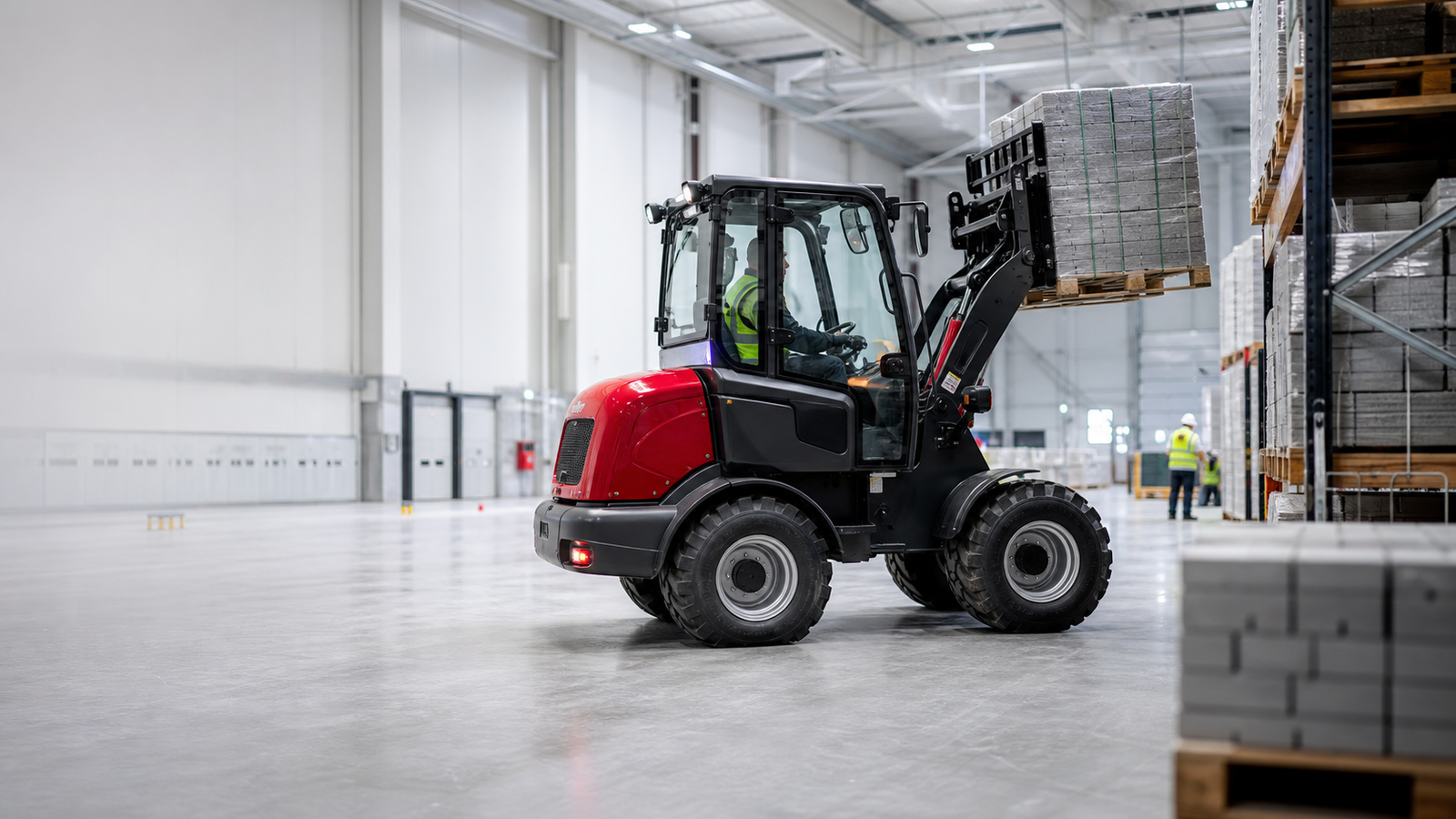
Low-Emission Material Handling – MERI Buyer Resource
Electric Compact Loader Charging and Duty-Cycle Guide
Battery capacity alone cannot predict whether an electric loader will complete a shift. Travel, lifting frequency, hydraulic attachment demand, idle time, temperature, gradients and operator behavior all change energy consumption.
Technical Factors to Confirm
| Decision area | What the buyer should verify |
|---|---|
| Duty cycle | Record loaded travel, empty travel, lift cycles, idle time and continuous auxiliary-hydraulic use. |
| Charging window | Identify available breaks, overnight hours and whether opportunity charging is permitted for the battery system. |
| Electrical supply | Confirm voltage, phase, frequency, socket/connector, breaker capacity and installation responsibilities. |
| Temperature | Cold and hot environments can affect performance, charging and battery life; confirm the operating range. |
| Attachment demand | Sweepers, augers and other continuous-flow tools can consume more energy than intermittent bucket work. |
Common Buying Mistakes
Incomplete application data
Suppliers cannot select responsibly when load, terrain, dimensions, work cycle and attachments are missing.
Headline-number comparison
A single capacity, width or power figure rarely explains stability, productivity, compatibility or operating cost.
- Comparing only battery nameplate capacity
- Assuming the charger fits the destination electrical system
- Ignoring continuous hydraulic attachments
- Planning a shift without charging margin or contingency
Information to Send With Your RFQ
- Hours per shift and shifts per day
- Travel distance, gradients and surface
- Loads and lift cycles per hour
- Attachment type and hydraulic usage
- Available charging windows
- Site voltage, phase and connector standard
- Ambient temperature and storage condition
When possible, include dimensioned site sketches, load photographs, terrain video and the destination country. MERI can then compare the relevant models, identify configuration questions and prepare a technical offer that is easier to review internally.
Buyer FAQ
How many hours will an electric loader operate?
Runtime depends on the confirmed battery and the measured duty cycle. Ask for an application-based estimate, not a universal hours claim.
Can the loader charge from any industrial socket?
No. Voltage, phase, frequency, connector and protective equipment must match the supplied charger and local electrical rules.
When is diesel still the better choice?
Diesel may suit remote sites, very long shifts or applications without suitable charging. Compare the complete operating system and service environment.
Build a Configuration for Your Application
Review the related MERI equipment and solution page, or send your work requirements for a model recommendation and quotation.
This guide supports preliminary product selection. Final capacity, dimensions, performance, compatibility, compliance and supplied documents depend on the confirmed model and order configuration.